

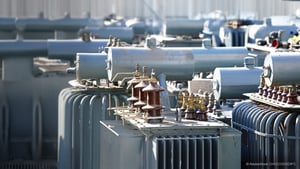
A typical scenario: transformer decommissioned – what happens next? A transformer is taken out of service – whether as part of a planned upgrade or due to a technical fault. Alongside the usual operational and logistical considerations, one question quickly arises: What happens to the insulating oil inside the transformer? Even though the transformer itself is no longer in use, the oil remains a key component that requires proper handling.
Why does the insulating oil of a decommissioned transformer require special attention?
Insulating oil is not a standard operating fluid. It plays a critical role in transformer performance and must therefore be handled appropriately after decommissioning.
Key aspects to consider include:
- Compliance with environmental and safety requirements
- Proper handling during draining and transport
- Correct assessment prior to further processing
Before any next steps are defined, a few essential questions need to be clarified:
- Is it mineral oil or another type of insulating fluid?
- Is a Polychlorinated Biphenyls (PCB) analysis available?
- What is the volume of oil involved?
In practice, the question of PCBs (polychlorinated biphenyls) is addressed at an early stage.
The key step: analysis and classification of the transformer oil
The process typically starts with taking a representative oil sample. This sample is analysed and forms the basis for all further decisions.
The focus is on the classification of the oil:
- Is it mineral oil, a synthetic fluid (e.g. silicone oil), or an alternative such as ester-based fluids?
- Is the transformer oil PCB-free?
These factors determine how the used oil can be handled, processed or, if necessary, disposed of. The general condition of the transformer oil is often less critical – even oils that have been in service for decades can still be suitable for further processing.
What happens to the used transformer oil?
Based on the analysis, several established pathways are available:
- Regeneration back to insulating oil
→ processed for reuse in transformers - Processing into base oil
→ reused as a raw material in other industrial applications - Professional disposal
→ where no viable recovery option is available
In many cases, recovery or reuse is possible, meaning that disposal is not necessarily required. As an experienced service provider, Electrical Oil Services (EOS®) assesses each case individually and determines the most appropriate and compliant route for the oil.
Learn more about our Closed Loop Model, supporting a circular economy:
Practical approach to deal with used insulating oil
In the UK and several other countries, the process is typically focused on the insulating oil itself.
A straightforward approach is usually followed:
-
A sample is analysed for PCB content before it is removed from the transformer
-
The used transformer oil is then collected
Depending on the volume, different options apply:
-
Larger quantities will be collected on site by a bulk tanker.
-
Smaller quantities (e.g. from around 500 litres) should be drained into barrels, which will then be collected on site.
The aim is a simple and efficient handling process, regardless of the transformer oil’s condition. Electrical Oil Services (EOS®) supports this process from initial enquiry through to collection and further treatment, ensuring a smooth and efficient handling of the oil.
|
Important! Used insulating oil is classed as a hazardous waste and therefore should only be moved between sites by a licensed hazardous waste carrier. |
Learn more:
- Used oil disposal: What type of used transformer oil does Electrical Oil Services accept?
- EOS® Mobile Processing Units: Electrical Oil Services operates Europe's largest fleet
- EOS® Closed Loop model minimises transformer oil waste
Conclusion: used transformer oil as a valuable resource
Even after a transformer has been decommissioned, insulating oil remains a valuable resource.
With the right assessment and treatment, the transformer oil can be:
- reused,
- further processed, or
- disposed of in a compliant manner.
A structured approach to handling used oil supports both regulatory compliance and resource efficiency.
With its technical expertise and many years of practical experience, Electrical Oil Services provides reliable support in identifying the most suitable solution for each specific case. If you have any questions or would like to discuss your specific situation, the EOS team is happy to assist you.